The South Will Ride Again Marta
This article originally appeared in our August 2012 issue.

At the heart of the rot eating at metro Atlanta is the Mother of All Mistakes: the failure to extend MARTA into the suburbs. Information technology wasn't only a former blunder—it was the single worst error in a whole cluster bomb of missteps, errors, power plays, and just plain meanness that created the region'due south transportation infrastructure.
As we look at the future of Atlanta, there'due south no question that battling our notorious traffic and sprawl is key to the metro area'southward potential vitality. What if there were a Back to the Futurity–type option, where we could accept a mystical DeLorean (heck, we'd settle for a Buick), ride back in time, and fix something? What effect would benefit nearly from the employ of a hypothetical "undo" key?
The transit compromise of 1971.
Before nosotros become into the story of what happened in 1971, we need to support a few years. In 1965 the Georgia General Assembly voted to create MARTA, the mass transit organisation for the City of Atlanta and the five core metro counties: Clayton, Cobb, DeKalb, Fulton, and Gwinnett. Cobb voters rejected MARTA, while it got blessing from the city and the four other counties. Although, as information technology turned out, the state never contributed any defended funds for MARTA'south operations, in 1966 Georgia voters approved a constitutional amendment to permit the state to fund 10 percent of the total toll of a rapid rail system in Atlanta. Two years later, in 1968, voters in Atlanta and MARTA'south cadre counties rejected a plan to finance MARTA through belongings taxes. In 1971—when the issue was presented to voters once more—Clayton and Gwinnett voters dropped their back up, and MARTA ended upwardly beingness backed by merely DeKalb, Fulton, and the City of Atlanta.
In 1971, given the lack of back up for MARTA by the five core counties, then Mayor Sam Massell came dorsum with a new plan: to provide an ongoing subsidy for MARTA through a sales tax levied in Fulton, DeKalb, and the City of Atlanta. No other jurisdiction in Georgia had a local option sales tax, and then the General Assembly had to approve the thought. When the notoriously anti-Atlanta legislators gave the become-alee, Massell called a press briefing that featured a flatbed truck pulling up in front of urban center hall, facing the Capitol, with a large billboard that said, "Thanks, Georgia Lawmakers!" Massell then dug a hole in the city hall lawn and cached a hatchet to symbolize his appreciation for the land'south rare back up of the city.
In a promotional stunt worthy of Mad Men, Massell sent a bevy of young women to the Capitol in pink hot pants with little keys to the urban center, a annunciation expressing the city'due south gratitude, and invitations to city hall for a lunch featuring fried craven (for Lieutenant Governor Lester Maddox), peanuts (for Governor Jimmy Carter), and, of class, Coca-Cola. "We got a iv-cavalcade picture show—the biggest exposure we always got from the Atlanta newspapers," recalls Massell, now president of the Buckhead Coalition.
After getting the legislative approval for the sales-taxation option, Massell had to persuade voters to pass the sales tax. "Nosotros were going to buy the existing bus company, which was then charging lx cents and a nickel transfer each way—$1.thirty a twenty-four hour period—and they were about to go out of concern. I promised the community we would driblet that fare to xv cents each way immediately," Massell says. The daily fare would plunge from $ane.30 to thirty cents. Non everyone believed him. City Councilman Henry Dodson cruised the city in a Volkswagen with a PA system that blared, "It's a trick! If they can't do it for sixty cents, how are they going to do it for 15?"
Massell countered the VW with higher visibility, chartering a helicopter to hover over the Downtown Connector, congested even and so, while he called through a bullhorn, "If you desire out of this mess, vote yes!"
"This beingness the Bible Belt, they idea God was telling them what to exercise," Massell quips today. Still, to make certain Atlantans voted his mode, he rode buses throughout the city, passing out brochures to riders, and he visited community groups with a blackboard and chalk to exercise the math on the sales taxation. Voters approved the program by just a few hundred votes.
Another of the blunders that crippled MARTA at the outset—and haunts information technology to this day—was engineered behind airtight doors by the segregationist Lester Maddox, according to Massell, who believes Maddox'south intervention was even more than devastating than the vote not to extend MARTA into the suburbs.
After the Georgia Firm of Representatives approved funding MARTA through the sales tax, Massell had to arroyo the Georgia Land Senate, where Maddox held sway. Maddox told the mayor he would block the vote in the senate unless MARTA agreed that no more than than 50 percent of the sales tax revenue would go to operating costs, Massell recalls. "He called me into his office and told me that was it. Either I swallowed that or he was going to kill it and it would not pass."
That has meant that whenever MARTA needed more than money for operating expenses, it had to cut elsewhere or heighten fares. As a result, MARTA has raised the fare over the years to today's $2.50, making it one of the priciest transit systems in the country.
Although the 50 pct limit has resulted in higher fares, few people realized the ramifications of the so-called "Maddox amendment" at the time, Massell says. In fact, information technology actually was viewed favorably by DeKalb legislators because they were afraid MARTA would spend all its money in Atlanta before extending rail service to DeKalb, according to a thirty-vi-page history of MARTA written by former State Treasurer Thomas D. Hills.
Hills'southward MARTA history as well illuminates why the country never contributed funds for MARTA, despite that 1966 vote that would have immune it to. One early on plan was for the MARTA sales tax to be iii-quarters of a penny, with the land chipping in up to x percent of the cost of the organization every bit approved past Georgia voters. Simply early on in his administration, according to Hills's history, then Governor Carter called MARTA attorney Stell Huie—who was on a quail-hunting trip—and said the state couldn't afford its $25 one thousand thousand share for MARTA. Carter offered to heighten the sales tax to a full penny if the state didn't have to pay, and Huie agreed. The lawyer said the 1 percent sales taxation plan came out of the House Committee on Ways and Ways and "there was a tag end, not even part of the act, that just said the land won't put any money in."
Hills wrote that the events assist to "explicate why some representatives of state government and others in the community empathise that the state's back up in assuasive the local option sales tax for MARTA was a bargain in exchange for a reprieve for the state from future funding for MARTA."
The 1965 and 1971 votes against MARTA by residents of Cobb, Clayton, and Gwinnett weren't votes almost transportation. They were referendums on race. Specifically, they were believed to be almost keeping the races apart. Consider the suburbanites voting back then. The formerly rural, outlying counties had exploded with an astonishing exodus of white people fleeing the city as the black population swelled during the civil rights era. This mass migration came at a time when Atlanta was known through its public relations rant as "The City Too Busy to Hate."
The 1960 demography counted approximately 300,000 white residents in Atlanta. From 1960 to 1980, around 160,000 whites left the urban center—Atlanta's white population was cut in half over two decades, says Kevin M. Kruse, the Princeton professor who wrote White Flight: Atlanta and the Making of Modern Conservatism. Kruse notes that skeptics suggested Atlanta'southward slogan should accept been "The City Too Busy Moving to Hate." "Racial concerns trumped everything else," Kruse says. "The more you lot think about information technology, Atlanta's transportation infrastructure was designed equally much to keep people autonomously every bit to bring people together."
In the early 1970s, Morehouse Higher professor Abraham Davis observed, "The real problem is that whites have created a transportation problem for themselves by moving further away from the central urban center rather than living in an integrated neighborhood."
The votes confronting MARTA were not the just evidence of the role of race in Atlanta's transportation plans. The interstate highways were designed to gouge their fashion through black neighborhoods. Georgia Tech history professor Ronald H. Bayor, author of Race and the Shaping of Twentieth-Century Atlanta, says the failure of the 1971 MARTA referendum in Gwinnett and Clayton was the first of the region'southward transportation problems considering of the lack of mass transit in the suburbs. Yet his enquiry goes dorsum to the racial reckoning backside the route of the interstate highway system that began construction in the 1950s.
The highway now chosen the Downtown Connector, the stretch where I-75 and I-85 run conjoined through the city, gutted blackness neighborhoods by forcing the removal of many working-grade blacks from the central business district. It could have been worse. The highway was starting time designed to run smack through the headquarters of the Atlanta Life Insurance Company, the urban center's major black-owned business organisation. "The original intention was to destroy that black concern," Bayor says. A protest past the black community saved the structure and moved the highway route a few blocks due east, where it even so managed to cut through the black community's main street, Auburn Avenue.
Interstate 20 on the due west side of town is a particularly egregious example of race-based road-edifice. Bayor wrote: "In a 1960 report on the transitional westside neighborhood of Adamsville . . . the Atlanta Bureau of Planning noted that 'approximately two to three years ago, there was an "understanding" that the proposed route of the West Thruway [I-20 W] would be the purlieus between the white and Negro communities.'"
The strategy didn't work, of grade, as whites fled past the tens of thousands. One of the unintended consequences of the race-based road-edifice is today's traffic jams. "What happened didn't change the racial makeup of the metro area but led to congestion within the metro area," Bayor says.
Aside from political vengeance and racial politics, another enormous factor was at play in transportation policies of the 1960s and 1970s: Atlanta'due south love affair with the machine. The keen migration out of the city started in the late 1950s—just as workers at General Motors' vast Lakewood assembly plant in southeast Atlanta put the finishing touches on one of the most iconic cars in history: the 1957 Chevy.
The allure of roaring around Atlanta in cool cars took over and never let go. Once MARTA started running, who would ride a charabanc or subway when they could bulldoze a sleek, powerful automobile and fill information technology with inexpensive gas? But the people who couldn't afford the car. MARTA became an isolated castaway, used primarily by poor and working-form blacks. Racist suburbanites brayed that the organization'southward acronym stood for "Moving Africans Rapidly Through Atlanta."
While MARTA was struggling to crank upwardly the jitney and rails system, the Country of Georgia and its powerful highway department had other, bigger ideas.
David Goldberg, a old transportation reporter for the Atlanta Periodical-Constitution, says the road-edifice binge that led to the gigantic highways that course through metro Atlanta—some of the widest in the world—macerated MARTA's potential. "It'south non a single mistake but a bunch of decisions that add together up to i big error—the failure to capitalize on the incredible success we had in winning funding for MARTA by undermining it with the incredible success we had in getting funding for the interstate highways," says Goldberg, at present communications manager for Washington-based Transportation for America. "Nosotros were likewise damn successful—information technology was an embarrassment of success. Similar a lot of nouveau riche, we blew it before we knew what to do with it."
As metro Atlanta'southward geographic expansion grew white-hot, developers had to motility homebuyers—those fleeing the urban center and others moving South from the Rust Belt—in and out of the new subdivisions they were carving from the pine forests and ruddy dirt. Georgia started "edifice highways expressly to enrich developers," Goldberg says. "A whole lot of land owners and developers who knew how to do suburban development had the ear of country government and the coin to buy influence. They took all that money nosotros had and put it into developing interchanges way out from town. A lot of what was new suburban development dorsum then is now underused, decaying, and role of an eroding tax base in the older suburban areas."
The vast highway system sucked upwardly billions of federal dollars while the state refused to put a penny into MARTA—until the past fifteen years, during which information technology helped buy some buses. "The sick joke of information technology all is that nosotros built the place to be car-oriented and designed information technology about every bit bad equally we could to part for auto employ," Goldberg says. "The highway network we did build was designed in a way almost guaranteed to produce congestion—the country use around all that development put the nail in the coffin." He refers to the neighborhoods total of cul-de-sacs that force cars onto crowded arterial roads lined with commercial activity, then force them to merge onto the freeways, which eventually funnel down to one highway through the heart of Atlanta.
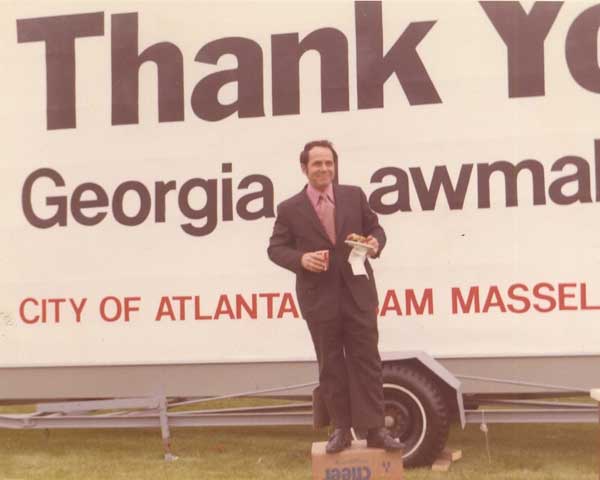
Photograph courtesy of Sam Massell
More than than forty years later, what does the failure to create MARTA every bit a regional system hateful for Atlanta? Christopher B. Leinberger, a senior fellow of the Brookings Institution and professor at George Washington Academy, has been watching Atlanta's growth—and refuse—for decades. In January he alleged, "Atlanta is no longer Hotlanta." He cited the free fall from the number eighty-ninespot on the listing of the earth's 200 fastest-growing metro areas to ranking at 189 in only five years. Not to mention the plunge of 29 percentage in average housing price per square foot between 2000 and 2010. Not to mention that Atlanta has the eleventh-virtually-congested traffic of 101 metro areas in the country.
"The big fault was not taking advantage of MARTA," Leinberger says. "Atlanta was given by the federal taxpayers a tremendous gift that they squandered as far equally MARTA. It's not just that Atlanta did not have advantage of it. They didn't aggrandize it and they didn't recognize that information technology could allow them to build a counterbalanced manner of developing."
Leinberger agrees that part of the region'southward blindness toward MARTA's potential was the conventionalities "that the car was the be-all and end-all forever. The other part was the basic racism that yet molds how Atlanta is built."
The nigh maddening realization is that the once well-nigh all-white suburbs that voted confronting MARTA years agone are today quite diverse and reflect Atlanta'due south development from a biracial city to a multiracial, multiethnic one. Today's suburbs are non only home to African Americans, but besides Latino, Asian, and Eastern European immigrants. The city'southward diversity is projected to increase over the coming decades (run into page 68). Many of the people who voted against MARTA decades ago are dead or retired. The suburban lifestyle they were so eager to defend has lost much of its cachet equally gas prices soar and houses don't sell. Smart young people up to their necks in college debt don't want to spend their money and time driving cars dorsum and along; they want to live in town. Atlanta'southward simply neighborhoods to gain inflation-adjusted housing value in the past decade, Leinberger notes, were Virginia-Highland, Grant Park, and East Lake.
The Georgia Sierra Social club's opposition to the July 31 referendum on a regional transportation sales taxation—on the grounds that the plan, despite including a bulk for transit, was a sprawl-inducing road expansion—troubled Leinberger. "That's a dangerous strategy. From what everybody tells me, this is a one-off." He says the state legislature has traditionally treated Atlanta like a child, and is proverb, "Finally, one time merely, children, are we going to let you decide for yourself. This is it."
The July 31 vote is "an Olympic moment," he says. "If the vote fails, you have to accept the fact that Atlanta will continue to pass up as a metro area." 40 years from at present, will we look dorsum at failure to pass the referendum every bit a mistake as devastating as the 1971 MARTA compromise?
Atlanta faces a classic trouble. It boomed in the go-get decades at the cease of the twentieth century when everyone zoomed lonely in their cars from home to office to store. Now it must move beyond what worked in the past to a new era that demands a new style of building, with up to seventy per centum of new evolution oriented around transit, Leinberger says. "Atlanta has a lot of catching upwardly to do, but it's difficult for old dogs to learn new tricks."
The never-ending ramifications of a race-based transportation infrastructure, built to suit a suburban driving lifestyle that has started to die off in a state that has traditionally refused to embrace mass transit, could doom Atlanta to a hereafter as a newer, sunnier Detroit.
"It only takes a generation-plus of yinning when you lot should have yanged to wake upward and say, 'Oh my God! How did it happen?'" says outgoing MARTA General Manager Beverly A. Scott, who watched from distant the decline of her hometown, Cleveland.
Atlanta's failure to build out MARTA looks even more shameful when compared with what happened with similar transit systems in San Francisco and Washington, D.C., which started at the same time as MARTA, she says. "The reality is, this region got stuck. Nosotros have about half the build-out of what it was planned to be." Merely San Francisco and Washington "kept building and moving . . . they had plans regardless of whether folks were red or blue. They had a vision and the fortitude to brand majestic and keep moving. Nosotros merely got stuck."
MARTA was built-in out of Atlanta'due south giant ego in the days when the city was entering the major leagues beyond the board—baseball game, football, international airport—bolstered past a racially harmonious reputation unmatched in the Due south, deserved or not. "Y'all said to yourself, 'We're top-notch. Everybody's got to take a track system,'" Scott says. "But it was built as a manifestation of 'we have arrived' without a bigger vision of 'what do nosotros desire to do for our region?' You built information technology similar a bays." Indeed, some of the Downtown MARTA stations were congenital on a calibration that would please a pharaoh.
Notwithstanding Scott says she is no doomsayer. During her tenure at MARTA, she has seen marked progress in forging the civic-political infrastructure necessary to build an integrated transportation network. Her concern is that the region is at a critically urgent juncture in the process and can't beget to lose focus or momentum."In that location's still much work to exist done," she says.
Word about Atlanta'due south transportation muddle has gotten around. Scott says she's been privy to meetings during which corporate relocation experts tell Chamber of Commerce members: "Hey, Atlanta is not simply not at the top tier anymore, nosotros've got companies proverb, 'Don't put the Atlanta region on the listing.'" It'southward not just the congestion and pollution—"they're not seeing leadership or plans to become yourself out of the fix."
Atlanta'south leaderless transportation prepare is the ultimate example of the admonition, "Be conscientious what y'all pray for."
"This is the irony: The majority of whites in Atlanta wanted to be isolated when they idea about public transportation," says historian Kevin Kruse. "Every bit a result, they take been in their cars on 75 and 85. They got what they wanted. They are safe in their own infinite. They're just not moving anywhere."
Retrospect: Other lapses in civic judgment
The 1818 Survey Snafu That Keeps Atlanta Thirsty
Surveyors in 1818 goofed when marking the edge betwixt Georgia and Tennessee. At least that's Georgia's story, and nosotros're sticking with information technology. Legislators still quarrel over the alleged historical cartography blooper that left all of the Tennessee River within Tennessee. Georgia claims surveyors prepare the boundary line likewise far south by more than a mile and should have included a sliver of the mighty river within our borders. During contempo astringent droughts, Georgia thirsted to stick a pipe into the Tennessee and road water to Atlanta, which now draws all its Water from Lake Lanier and the Chattahoochee River, whose water is besides lusted after past Alabama and Florida. Another mistake is our failure to build additional reservoirs —but being addressed now.
The "Grow No More" Edict of 1953
The city of Atlanta hasn't extended its boundaries in the terminal lx years, while the population and landmass of the surrounding counties has exploded. The last fourth dimension Atlanta expanded its limits was 1952, when it took in Buckhead and went north—virtually to Sandy Springs. Timothy Crimmins, who directs the Heart for Neighborhood and Metropolitan Studies at Georgia State University, thinks Atlanta's biggest mistake—bigger than the MARTA compromises—was a 1953 decision by the state supreme courtroom that declared unconstitutional an try by the local legislative delegation to addendum additional parts of Fulton County. The courtroom said only the Full general Assembly could expand city limits—and the referendum sought to preempt that power. Information technology was a critical opportunity that would have set up up a primal government that could grow with our expanding population instead of the proliferation of regional governments.
The last major effort at annexation was Sam Massell's "Two Cities" plan of the early 1970s, which called for Atlanta to annex unincorporated Fulton Canton northward of the city, and College Park to annex unincorporated Fulton to the south. The program passed in the House of Representatives and was set to laissez passer in the Senate, but information technology was killed by Lester Maddox. Ironically, segregationist Maddox stopped looting that would have returned Atlanta to a majority-white city. Adjusting racial allotments "was non the motivation" for the plan, Massell says. What he was after was a urban center with a greater population, and thus greater power. Crimmins says Maddox killed the bill at the request of black leaders and the Urban center of East Point.
Our Sewer Woes—Dating Back to Reconstruction
In the years after the Ceremonious War, Atlanta built a two-piping sewer system: a separate but integrated network of pipes that collects sewage and storm water. During downpours, rainwater forced raw sewage into the Chattahoochee. As the population grew, the pollution became grotesque. In 2001 the city agreed to federal and state demands to fix the problem with giant hugger-mugger tunnels to store the overflow and then ship information technology for handling. The Clean Water Atlanta program has cost $ane.6 billion then far and volition cost another $450 million over the adjacent xiii years. This is why Atlantans accept among the nation'due south highest water-sewer bills. The situation in the suburbs may exist worse because so much wastewater treatment is the responsibility of individual homeowners with septic tanks. "The pollution potential for that is gargantuan," Crimmins says.
This article originally appeared in our August 2012 issue.
Source: https://www.atlantamagazine.com/great-reads/marta-tsplost-transportation/
0 Response to "The South Will Ride Again Marta"
Post a Comment